




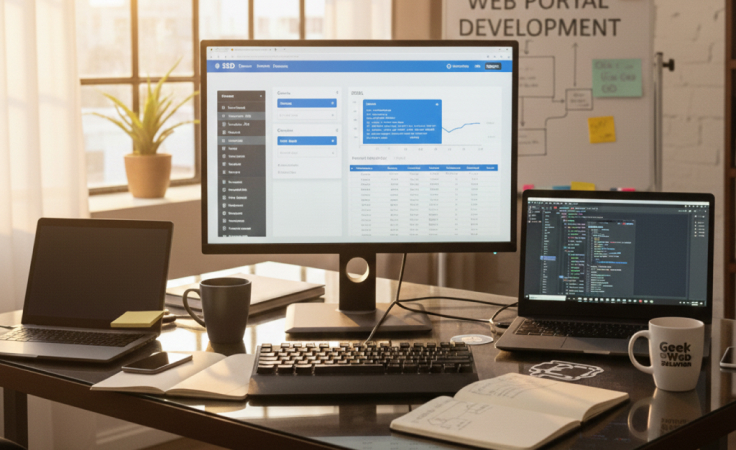
Honestly, we stumbled into web portal development services by accident. One of our early clients was a textile company in Gujarat struggling with chaos. Different departments had their own spreadsheets, their own systems, their own way of doing things. Sales didn’t talk to operations. HR couldn’t track anything properly. The owner was frustrated enough to let us try something different.
We built them a simple custom web portal development solution where everyone could see the same information. Sales could check inventory before promising delivery dates to customers. Operations could see orders coming in real-time instead of waiting for weekly reports. HR could actually track employee records without digging through files.
That project changed something for us. We realised that custom web portal development wasn’t really about technology. It was about fixing how people work together. And once we saw it work, we couldn’t stop building portals. That’s when Geek Web Solution started focusing heavily on providing web portal development services to businesses across India and beyond.
Here’s the thing about portals and how people define them: a web portal is essentially giving someone a key to your operation. It’s not just another website or app.
When your employee logs into your portal, they’re not just browsing. They’re accessing their actual tools. They’re checking real data. They’re doing their job. A sales guy sees his sales dashboard, his customer list, and his pipeline. A customer logs in and sees their invoices, orders, tracking information, and support tickets all in one place.
We’ve seen companies spend money on beautiful portals that nobody uses because the portal doesn’t match how people actually work. Then we build something basic but useful, and everyone uses it because it solves their real problem.
The best way to think about it: a portal is where your business actually lives. Everything your people need to do their job should be there. Not perfect. Not beautiful necessarily. But useful. Real. Connected to your actual operations. This is what separates a good web portal development company from one that just creates pretty interfaces.
We’ve been doing this long enough to see the before and after. It’s dramatic.
A company we worked with had its customer support team spending their entire day pulling information from different places. One system had order information. Another had shipping data. Another had a customer communication history. Support staff were like archaeologists, digging through systems to find what they needed.
We built them a customer web portal development solution. Now, when a support person opens it, everything about that customer is right there. They solve problems faster. Customers are happier because they get answers quicker. Support staff are happier because they’re not spending hours searching.
That company saw its support costs drop 35 percent. But more importantly, their customer satisfaction went up. That’s not a coincidence.
We’ve also worked with manufacturing companies where how to develop a web portal became their critical question. The production floor couldn’t see demand planning. Marketing didn’t know what was being made. Finance had no idea what inventory was sitting around. We built them a portal that everyone could access. Now production sees actual orders. Marketing plans campaigns around what can actually be produced. Finance gets accurate data.
Nobody is sitting around waiting for emails or meetings anymore. Information just flows.

We don’t build the same portal twice. Every company is different. Whether you need B2B web portal development for vendors or employee portals, our approach is tailored.
For employees internally, we build what people call intranet portals. These are just for your team. HR policies, company announcements, training materials, team directories, and project collaboration spaces. We built one for a software company where developers could see who was working on what, share code snippets, ask questions. It actually changed their collaboration. People stopped sending hundreds of emails and just posted in the portal.
For customers, the customer web portal development solution is like your store that never closes. Customers can check their order history anytime. They can track shipments. Download invoices without calling. Submit support tickets. Read FAQs and solve their own problems. We worked with an ecommerce company where building this dropped their support calls by 40 percent. Seriously. Customers didn’t call anymore because they could handle everything themselves.
For B2B relationships, web portals are different. A supplier needs to see what you’re ordering, what their sales are, and what inventory you have. We’ve built B2B web portal development solutions for distribution networks where suppliers could actually see demand patterns. They started being smarter about inventory because they had visibility. It helped their business and helped our client’s business. These B2B web portal development projects require different security considerations and data visibility rules than consumer portals.
For information and knowledge, we’ve built portals that are basically search engines for company information. One client had over 5000 documents scattered everywhere. Nobody could find anything. We made everything searchable and taggable. Now people find what they need in seconds instead of hours or never.
We’ve made every mistake in the book and learned from them. This is why our approach to web portal development services is different.
First mistake: building what you think people need instead of what they actually need. We learned this the hard way. We built a complex portal with amazing features that management loved. Users hated it. It sat there gathering dust. Since then, we actually watch people work. We ask questions. We let them test early versions. What they actually want is usually different from what we think they want.
Second mistake: too many features at once. We’ve learned to launch with just the core stuff. People use it. It works. Then they tell us what else they need. We add that. It’s slower, but it works so much better. This is especially true when doing custom web portal development services, where complexity can kill adoption.
Third mistake: forgetting about phones. Everyone’s on their phone now. We used to build portals that worked on desktop but were painful on mobile. Now we start with the mobile in mind. Everything works on a phone first. Then it looks great on a big screen too.
Fourth mistake: underestimating how hard it is to connect everything. Every company has legacy systems. Old databases. Multiple tools that don’t talk to each other. Making it all talk to the portal takes more time and money than people expect. Now we’re honest about this upfront when clients ask us how to develop a web portal. We spend weeks just planning integrations.
Fifth mistake: assuming people will just use it. They won’t. You have to help them learn. Train them. Make it easy. Some of our clients assign someone to just help people use the portal for the first month. It pays off because adoption is fast.
When someone calls Geek Web Solution about custom web portal development or web portal development, here’s what we do:
We visit them. We watch how people work. We ask the owner what keeps them up at night. What’s broken? What’s frustrating people? We’re not looking for technical problems. We’re looking for business problems.
Then we ask the people doing the actual work. What do you spend time on that’s stupid? What information do you need that you don’t have? Where are the bottlenecks? You’d be surprised how often the problems are totally different from what management thinks.
We go back to our office and sketch out on whiteboards. Not fancy designs. Just rough sketches showing how the portal could work. Screens, buttons, information flow.
We show them the sketches. They point out what’s wrong. We iterate. Sometimes it takes three or four rounds before we get it right.
Then we start building. We don’t build everything at once. We build the most important features first. Get them working. Get feedback. Then build more.
We test everything. Not just whether features work, but whether users can actually figure out how to use them. If someone can’t figure something out, we redesign it.
We launch. We don’t disappear. We’re around to help people learn and to fix problems that come up.
People always ask what results look like. Here’s what we’ve actually seen from our web portal development services:
An e-commerce company had customers calling about orders constantly. We built a customer portal. Calls dropped 41 percent. These aren’t people still calling, they’re just not calling anymore because they can see everything online.
A manufacturing company had their support team manually pulling information from three systems for every customer question. We built them a unified portal. The same support team now handles 50 percent more requests because they’re not wasting time searching for information.
A healthcare company built a patient portal. Patients could see their test results and medical records online instead of waiting for doctors to call them. Patient satisfaction went up. The doctor’s office got fewer calls asking about results.
A financial services company had customers coming in with questions about their accounts. They built a portal. In-person visits dropped 25 percent because customers could see everything online. That freed up staff to handle more complex situations that actually needed attention.
None of these was because the portals were beautiful or had tons of features. They worked because they solved real problems. Customers got answers without calling. Employees could find information without searching. Operations got visibility into what was actually happening.
Web portal development services aren’t magic. It’s not going to fix a broken business. But if your business is solid and you’re just struggling with how information moves around, a portal helps.
We’ve learned that the simple portals win. The ones focused on solving one or two real problems. Not the ones with every feature anyone could possibly want.
We’ve learned that your users matter more than what we think. If we build what they actually need instead of what we think is clever, it works.
We’ve learned that going live is just the beginning. The real success comes from how you help people adopt it, support it, and improve it over time.
And we’ve learned that sometimes the best thing we can do is tell a client, “We don’t think a portal is your problem right now.” A few have listened. The ones that did avoided wasting money and solved their actual problems instead.
If you’re thinking about web portal development, whether you need custom web portal development services, B2B web portal development, or customer web portal development, talk to us. We’ll ask a lot of questions before suggesting anything. If it makes sense, we’ll build something that actually works. If it doesn’t make sense, we’ll tell you that too.
Web portal development services are supposed to make your business work better. That’s all that matters. Reach out to Geek Web Solution today and let’s talk about what’s actually broken in your operation and how a portal could fix it.