




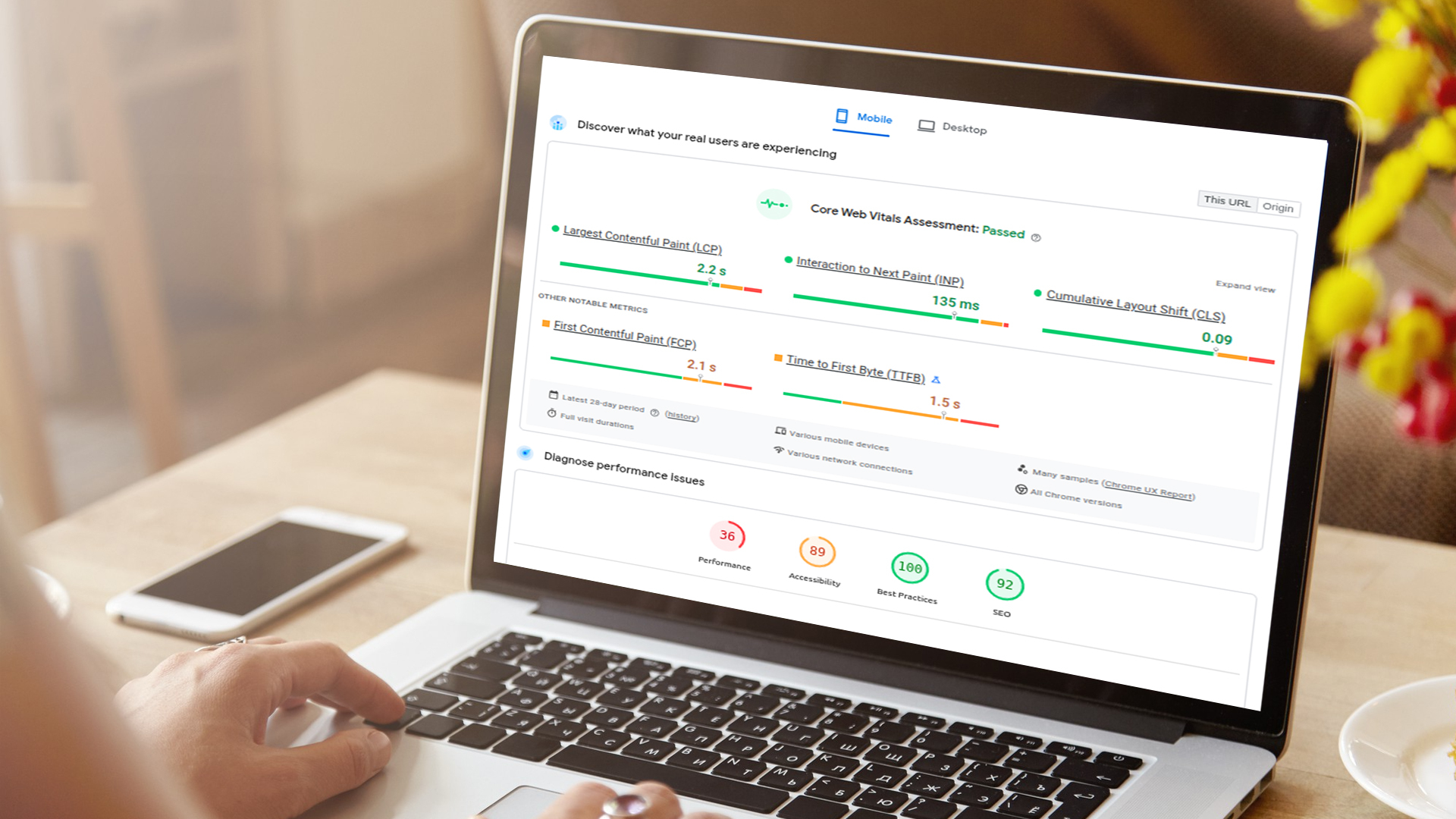
Your website could be well-written, keyword-optimized, and backed by solid backlinks. But if it takes more than 3 seconds to load, a large chunk of your visitors is already gone. And Google has noticed.
Page speed is one of the most talked-about topics in SEO, yet most businesses still treat it as an afterthought. They focus on content and links, then wonder why they are stuck on page two. The reality is that page speed and SEO are deeply connected. Understanding that connection is what separates websites that rank from websites that don’t.
Let’s go deep.
Page speed is how fast your website’s content loads and becomes usable when someone visits a page. But here’s where most people get it wrong. Page speed is not one single number.
Google doesn’t look at your website through one lens. It uses a set of specific performance metrics, each measuring a different part of the user experience.
There are two types of data Google collects:
Lab data is what tools like Google PageSpeed Insights and Lighthouse generate. It is a synthetic test run in a controlled environment. Useful for diagnosis, but not what Google actually uses to rank your site.
Field data officially called the Chrome User Experience Report (CrUX), is real-world performance data collected from actual Chrome users visiting your site. Page speed data from the CrUX report is what Google uses as a direct SEO ranking signal, not your lab score. Most website owners optimize for their PageSpeed Insights number and miss the point entirely.
In 2021, Google formalized page speed into a framework called Core Web Vitals. These metrics measure load time, interactivity, and visual stability, and they have become deeply integrated into how Google evaluates overall site quality.
LCP measures how long it takes for the biggest visible element on your page to fully appear on screen. This is usually a hero image, banner, or main heading.
To get a good score, your website needs to load within 2.5 seconds as measured by LCP. You will receive a “Poor” rating from Google if your website takes more than 4 seconds.
LCP is the most critical of the three. If someone clicks your link and stares at a blank screen for 3 seconds, they leave. That bounce tells Google your page didn’t deliver.
INP replaced FID (First Input Delay) in March 2024 and is now the official Core Web Vital for interactivity. It measures how quickly your page responds after a user clicks something, such as a menu, a button, or a filter.
A good INP score is under 200 milliseconds. Poor is anything above 500ms.
Most businesses obsess over load speed and completely ignore INP. Meanwhile, sluggish JavaScript making every click feel sticky is silently hurting their rankings.
CLS measures how much your page visually jumps around as it loads. You’ve experienced this before. You go to click a link, then an ad loads above it and you accidentally tap something else.
A good CLS score is under 0.1. Poor is above 0.25.
It looks like a minor technical issue. But Google treats unexpected layout shifts as a bad user experience, because they are.
Here’s something most articles miss. Page speed affects your rankings in two distinct ways, and both are real.
If your page speed is fast, your Core Web Vitals improve, which improves the page experience signal, which directly affects your rankings. Google confirmed page speed as a mobile ranking factor in 2018. By 2021, Core Web Vitals became part of the broader Page Experience signal used for both mobile and desktop.
While page speed typically isn’t the most influential ranking factor on its own, it can be the decisive differentiator when competing pages have similar content relevance and authority. Think of it as the tiebreaker. Two pages with near-equal content quality and backlinks: the faster one wins.
This is where the real damage happens. When a site loads slowly, users are more likely to abandon it, view fewer pages, and spend less time engaging with content. Over time, these behavioral patterns shape how search engines interpret your site’s value.
High bounce rate. Low dwell time. Poor engagement metrics. Google reads all of this as a signal that your page didn’t satisfy the user’s query. It then ranks your page lower, not because of your speed directly, but because of what your speed is causing.
Slow sites increase bounce rates by up to 90%. That number alone should alarm any business owner relying on organic traffic.
Google classifies Core Web Vitals performance into three tiers: Good, Needs Improvement, and Poor. For LCP, “Good” means under 2.5 seconds. For INP, under 200ms. For CLS, under 0.1. Aim for all three to pass Google’s Core Web Vitals assessment, as this directly feeds into the Page Experience ranking signal. Always prioritise your actual load time in seconds over your numeric PageSpeed score.
You can’t fix what you don’t understand. These are the most common culprits found when auditing websites, and none of them are obvious from the outside.
Unoptimized images are the number one offender. A 4MB JPEG hero image will destroy your LCP every time. Images should be compressed, correctly sized, and served in modern formats like WebP or AVIF.
Render-blocking JavaScript means your browser is waiting to download and execute scripts before it can display any content. Third-party scripts like live chat widgets, analytics, and advertising tags are especially damaging.
Slow server response (TTFB) is a foundational issue that no amount of front-end optimization can fully fix. Time to First Byte is how long your server takes to respond to a request. Bad hosting means high TTFB. Shared servers handling too many simultaneous requests will always slow your site down.
No browser caching means returning visitors download your entire site fresh on every visit. Caching stores static files locally so repeat loads are dramatically faster.
No CDN (Content Delivery Network) means every visitor’s request travels to a single server, no matter where in the world they are. A CDN stores copies of your site on servers in multiple locations, including across India, so pages load from the nearest point geographically. For businesses serving customers across India or internationally, this makes a real difference.
Code bloat from unused plugins, unminified CSS, and stacked page builders slows load time gradually and invisibly. An off-the-shelf CMS carries code that isn’t relevant to your specific site, and that code slows your load times considerably.
These tools are free and require no technical knowledge to use.
Google PageSpeed Insights (pagespeed.web.dev): Enter your URL, get a score for both mobile and desktop, and see specific fixes prioritized by impact.
Google Search Console: Under the “Experience” section, your Core Web Vitals report shows which pages are passing and which are failing, based on real user data.
GTmetrix: More granular than PageSpeed Insights. Useful for identifying exactly which files and requests are causing delays.
One important note: always look at your mobile score first. With mobile-first indexing, Google primarily uses the mobile version of your site to evaluate and rank pages. A fast desktop site with a slow mobile experience is still a slow site in Google’s eyes.
Websites that reduced their LCP by just one second saw a 17% boost in organic traffic. Businesses that fixed their Cumulative Layout Shift scores saw an 11% drop in bounce rate and a 20% increase in user engagement.
One performance agency found that fixing Core Web Vitals for a client increased their page 1 rankings by 28%. Another business that improved their Core Web Vitals assessment saw Google impressions jump by 300%.
These aren’t theoretical improvements. They are the direct, measurable result of treating page speed as a serious SEO priority.
Content quality is more important than Core Web Vitals as a ranking factor. Google’s search relations team lead John Mueller has stated that Core Web Vitals are “not giant factors in ranking” and that you wouldn’t see a big ranking drop from that alone.
So no. Page speed will not outrank great content and strong authority on its own.
But think about what it does do. It determines whether your content gets read or abandoned. It decides whether Google’s crawler efficiently indexes every page on your site, or runs out of crawl budget halfway through. It sets the baseline user experience signal that influences every other behavioral metric Google watches.
Page speed is probably the purest of all SEO factors, because addressing it improves your rankings, your user experience, and your conversion rate simultaneously. Few SEO actions give you that across the board.
Page speed affects SEO both directly and indirectly. Directly, Google uses Core Web Vitals (LCP, INP, and CLS) as part of its Page Experience ranking signal. Indirectly, slow pages cause high bounce rates and low dwell time, which Google interprets as poor quality and ranks the page lower as a result.
For SEO, Google recommends an LCP under 2.5 seconds, an INP under 200 milliseconds, and a CLS score below 0.1. Passing all three places your site in the “Good” tier of Google’s Core Web Vitals assessment.
No. Content quality remains the most important ranking factor. However, page speed acts as a tiebreaker between equally strong pages and determines whether your content is even engaged with, making it essential for any serious SEO strategy.
Core Web Vitals are three performance metrics Google uses to measure real-world user experience: Largest Contentful Paint (LCP) for loading speed, Interaction to Next Paint (INP) for responsiveness, and Cumulative Layout Shift (CLS) for visual stability.
Page speed is not optional. It’s not a nice-to-have. It’s the technical foundation underneath everything else you’re doing in SEO.
Great content on a slow website is an investment that never fully pays off. You earn the traffic, and then the load time takes it away.
Get your Core Web Vitals passing. Start with LCP. Fix your images. Address your hosting. Then measure, monitor, and maintain, because website performance isn’t a one-time fix. It’s an ongoing commitment.
If you’d like a deep look at how your website is performing right now, across speed, Core Web Vitals, mobile experience, and technical SEO, we’re happy to run a full audit. No pitch. Just a clear picture of where things stand and what to prioritise first.