

You have a limited marketing budget and two giant platforms fighting for it. One promises to put you in front of people who are already searching for what you sell. The other promises to introduce your brand to thousands of people who have never heard of you. Both sound great. But which one actually delivers results when you are working with real-world budgets and not just hypothetical scenarios?
This is the decision that trips up most small business owners in 2026. And after helping hundreds of businesses across industries navigate paid advertising, we can tell you this: the answer is not about picking one platform. It is about understanding what each one actually does, so you stop wasting money on the wrong one at the wrong time.
Let us break this down properly.
Before comparing costs, features, or ad formats, you need to understand one fundamental concept. It will save you from making the most expensive mistake in digital advertising.
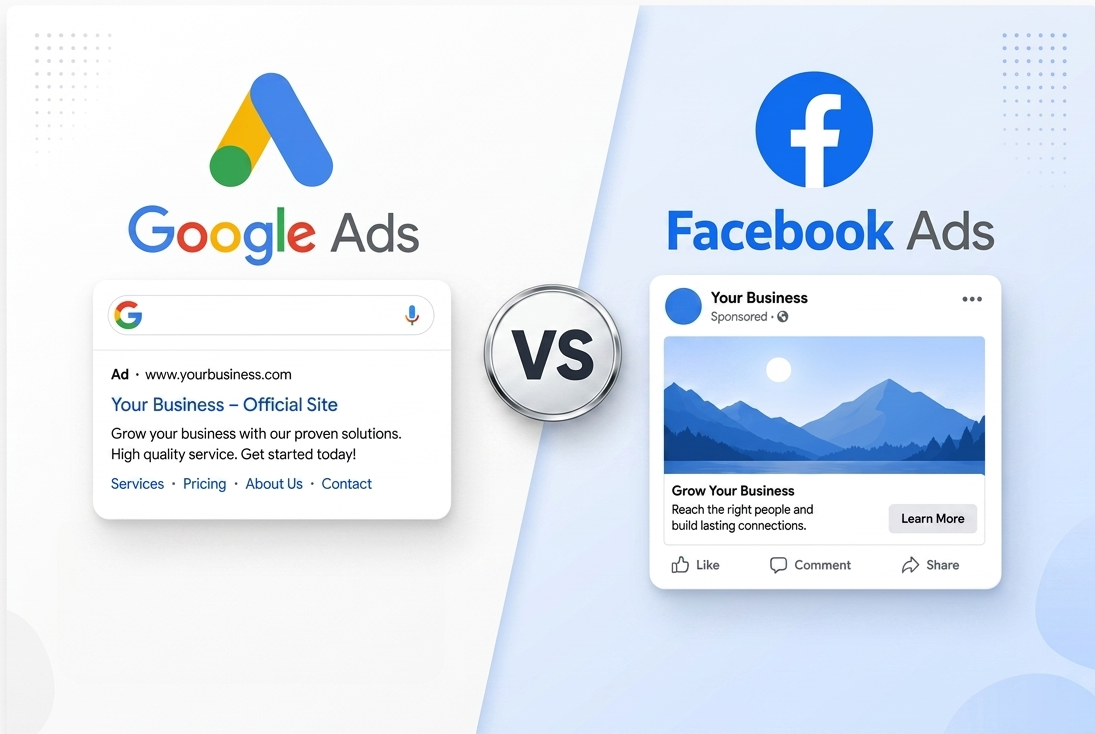
Google Ads captures existing demand. Facebook Ads create new demand.
When someone opens Google and types “best CRM software for small business” or “web development company near me,” they already have a problem and they are actively looking for a solution. Google puts your ad in front of them at that exact moment. You are not interrupting anyone. You are answering a question they already asked.
Facebook works the opposite way. Nobody opens Instagram or Facebook thinking, “I need to buy project management software today.” They are scrolling through reels, checking friend updates, and watching videos. Your ad appears in between all of that. You are creating awareness among people who were not looking for you. They might be interested, but they were not searching.
This is not a small distinction. It shapes everything from how much you pay per click to how quickly you see a return on your investment.
Let us talk real costs, because vague comparisons do not help you plan a marketing budget.
Facebook Ads are cheaper on the surface. The average cost per click globally is around $0.62, compared to $2.69 for Google Search Ads. For businesses operating in India, the gap is even more dramatic. Facebook clicks can cost as little as ₹5 to ₹12, while Google Ads typically range from ₹15 to ₹50 per click depending on your industry. High-competition verticals like finance, real estate, and legal services push Google CPCs even higher, sometimes crossing ₹200 per click.
But here is what those numbers do not tell you.
A ₹5 click from Facebook might come from someone who casually tapped on your ad while scrolling through memes. A ₹40 click from Google comes from someone who typed “hire web developer in Surat” into the search bar. That Google click is four to five times more likely to turn into a paying customer because the person already has purchase intent.
Cheaper clicks do not mean cheaper customers. The metric that matters is cost per acquisition, which is how much you spend to actually get a lead or sale, not just a click.
Google Ads works best when people are already searching for what you offer. If your business solves an urgent or specific problem, Google should be your starting point.
Think about businesses like plumbing services, dental clinics, legal firms, SaaS products, or IT service companies. When someone searches “emergency plumber near me” at 10 PM, they are not browsing. They need help right now. A Google Ad at that moment converts almost immediately.
Google also wins for businesses where the buyer already knows what they want and is comparing options. Searches like “Shopify vs WooCommerce,” “best accounting software for startups,” or “WordPress development company” indicate someone who is ready to make a decision. They just need the right option to appear.
The conversion cycle with Google is short. Someone searches, clicks your ad, lands on your page, and takes action, often within the same session. For service businesses and B2B companies, this speed matters because every day a lead sits in your pipeline without converting costs you money.
Facebook is not about catching people who are already interested. It is about making people interested in the first place.
This makes Facebook ideal for businesses that sell products people do not actively search for. Think fashion brands, lifestyle products, food delivery services, online courses, or new-to-market products that people do not know exist yet.
Facebook’s real power is in its targeting precision. You can reach people based on their age, interests, behaviour, job title, and even life events. Want to show ads for baby products to new parents in Mumbai? Facebook lets you do that. Want to target small business owners who are interested in digital marketing? You can build that audience in minutes.
The platform also excels at visual storytelling. If your product looks great on camera, or if you can create engaging video content, Facebook and Instagram give you a canvas that Google simply does not offer. Reels and Stories ads in particular have lower cost-per-impression rates in 2026, making them excellent for brand awareness campaigns.
But here is the catch. Facebook requires patience. Unlike Google, where conversions can happen in one session, Facebook’s conversion cycle is longer. A user might see your ad today, visit your website tomorrow, come back via a retargeting ad next week, and finally buy two weeks later. If you are measuring success purely by same-day conversions, Facebook will always look underperforming compared to Google. That does not mean it is not working. It means the buying journey is different.
The smartest businesses in 2026 do not pick one platform and ignore the other. They build a system where both platforms play complementary roles.
Here is a practical framework that works for most small businesses. Start with Google Ads to capture high-intent traffic. These are the people who are already searching for your product or service. Let Google bring in the leads who are ready to buy right now.
Then use Facebook Ads to retarget those website visitors who did not convert on their first visit. Someone clicked on your Google Ad, browsed your services page, but did not fill out the contact form. A well-timed Facebook retargeting ad reminds them about your business while they are scrolling through their feed. This combination shortens the sales cycle and improves your overall conversion rate.
Once your retargeting engine is running, you can start using Facebook for top-of-funnel awareness campaigns. Show your brand to cold audiences who match your ideal customer profile. Some of them will search for your brand on Google later, and your Search Ad will be there to catch them.
This creates a loop. Google catches demand. Facebook builds demand. Retargeting closes the loop.
If you are spending your first ₹30,000 per month on ads, here is a reasonable starting split:
Allocate 60% to Google Ads if your business is service-based and depends on people searching for what you do. Put the remaining 40% into Facebook for retargeting and brand building. If your business is product-based or visual in nature, flip the ratio and put 60% toward Facebook and 40% toward Google Shopping.
After 30 days, look at your data. Which platform has a lower cost per lead? Which leads actually convert into paying customers? Adjust your budget based on real performance, not assumptions.
Google Ads and Facebook Ads are not competitors. They are complementary tools that solve different parts of the same problem: getting more customers for your business. Google captures the demand that already exists. Facebook creates demand where none existed before.
The businesses that win in 2026 are the ones that stop asking “which platform is better” and start asking “how do I use both together effectively.” Build the system. Track the numbers. Let the data decide where your next rupee goes.