



There is a good chance you already know what digital marketing is in theory. It is marketing done through the internet. But that textbook answer has never helped anyone decide where to spend their next marketing rupee. What most business owners actually want to know is this: how does digital marketing work in practice, what parts of it matter for my business, and what kind of results can I actually expect?
That is what this guide is built to answer. Not with jargon, not with buzzwords, but with real clarity.
Strip away the complexity and digital marketing comes down to one idea: reaching the right people, in the right place, at the right time, using the internet.
When someone in your city opens Google and types “best web development company near me,” that is a digital marketing opportunity. When a potential customer scrolls through Instagram and sees a compelling ad for your product, that is another one. When someone on your email list opens a newsletter with a discount code and makes a purchase, that is digital marketing doing its job.
Every time you use a website, a search engine, social media, email, or an online ad to connect with potential customers, you are doing digital marketing. The difference between doing it well and doing it poorly is understanding which channels work for your specific business and how to measure what you get back from every rupee you invest.
The numbers tell a clear story. India now has over 900 million internet users, making it the second-largest online market in the world. The digital advertising industry in India has crossed ₹49,000 crore and is projected to reach nearly ₹70,000 crore by the end of 2026. Mobile devices account for 78 percent of all digital ad spending in the country, which means your customers are not sitting at desks browsing websites. They are on their phones, making decisions in real time.
Here is what this means for you. If your business is not visible online, you are invisible to the majority of your potential customers. Ten years ago, a good location and word of mouth could carry a business. Today, the first thing people do before visiting a shop, hiring a service provider, or buying a product is search for it online. If your business does not show up during that search, someone else’s will.
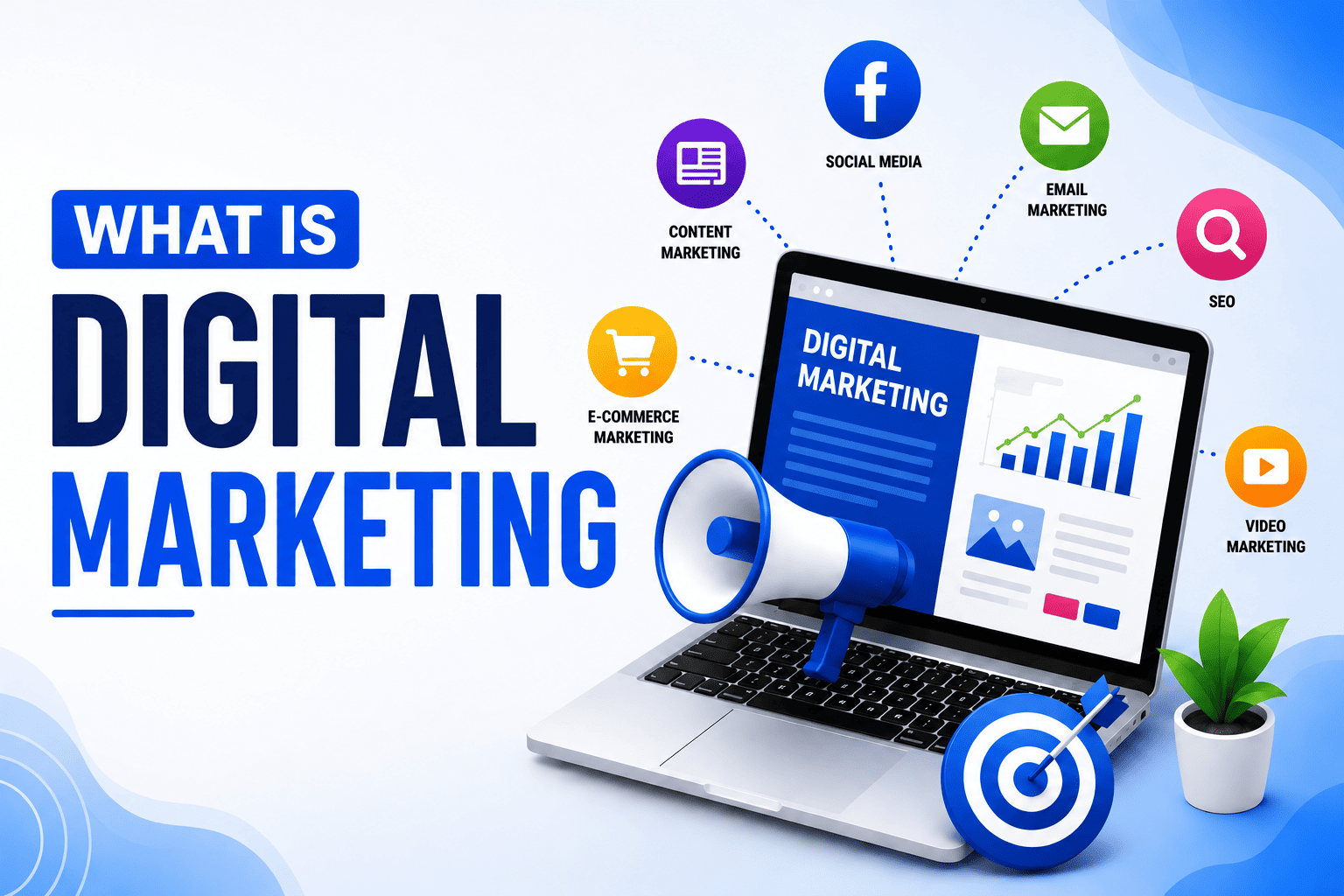
Digital marketing is not one thing. It is an ecosystem of channels that work together. Understanding what each one does helps you decide where your time and money should go.
Search engine optimization is the practice of making your website show up when people search for what you offer on Google. When someone types “eCommerce development company in Surat” and your website appears on the first page, that is SEO at work. It is a long-term investment. Results take three to six months to build, but once you rank, you get consistent traffic without paying for every click. For service-based businesses, this is often the highest-return channel over time.
Pay-per-click advertising is the fastest way to get in front of people who are actively searching. Google Ads and Meta Ads are the two dominant platforms. With PPC, you pay only when someone clicks your ad. The advantage is speed. You can launch a campaign today and start getting leads by tomorrow. The disadvantage is that traffic stops the moment you stop paying. It works best when combined with SEO as a short-term engine while your organic rankings build up.
Social media marketing puts your brand where people spend their free time. Instagram, LinkedIn, Facebook, and YouTube are the main platforms for Indian businesses. Social media is less about direct selling and more about building familiarity and trust. When someone sees your brand consistently sharing useful content, they remember you when they are ready to buy. For product-based businesses and personal brands, this channel is essential.
Content marketing is the strategy behind everything you publish. Blog posts, videos, infographics, case studies, guides. Good content attracts visitors, builds trust, and positions your business as an expert. The article you are reading right now is an example. It is designed to answer a question you have, provide value, and introduce you to what we do. That is content marketing in action.
Email marketing remains one of the most profitable channels in digital marketing, even in 2026. Industry data consistently shows that email generates a return of roughly 36 to 42 times what you spend on it. The reason is simple: you are speaking directly to people who have already shown interest in your business by sharing their email address. Newsletters, product launches, seasonal promotions, and re-engagement campaigns all fall under this umbrella.
Affiliate and influencer marketing works by letting other people promote your product in exchange for a commission or fee. This model is growing fast in India, with the influencer marketing industry projected to reach approximately $400 million by 2026. For product-based businesses, partnering with the right creator can put you in front of a highly engaged audience that already trusts the person recommending your product.
Web development and design is not typically listed as a digital marketing channel, but it should be. Your website is the foundation that everything else sits on. An ad campaign can bring a thousand visitors to your site, but if the site loads slowly, looks outdated, or makes it hard to take action, those visitors leave without converting. Design, speed, mobile responsiveness, and user experience are marketing decisions as much as they are technical ones.
The biggest misconception about digital marketing is that you need to pick one channel and go all in. In reality, the most effective strategies combine multiple channels into a system where each one supports the others.
Here is a practical example. You write a detailed blog post targeting a keyword your customers are searching for. That is content marketing and SEO working together. You share that blog post on LinkedIn and Instagram. That is social media amplifying your content. Someone reads the post and signs up for your email list through a lead magnet at the bottom of the article. Now email marketing takes over, nurturing that reader toward a purchase or inquiry. Meanwhile, you run a Google Ad targeting the same keyword for immediate visibility while your SEO builds momentum.
No single channel did all the work. But together, they created a path from stranger to customer.
If you are a service-based business like a web development agency, IT consultancy, law firm, or healthcare clinic, start with SEO and Google Ads. Your customers are already searching for what you offer. You need to be visible when they do.
If you sell physical products or run an online store, start with social media ads and Google Shopping. Visual platforms like Instagram and Facebook are ideal for product discovery, and Shopping Ads catch buyers who are comparing options.
If you are a B2B company selling software, services, or consulting, LinkedIn combined with content marketing and email is your strongest combination. Decision-makers in B2B do not impulse-buy from an Instagram ad. They read, research, and evaluate over weeks or months.
Regardless of which channel you start with, your website needs to be ready first. A fast, professional, conversion-focused website is not optional. It is the prerequisite that makes every other channel effective.
Digital marketing is not complicated in concept. It is reaching your customers through the internet using the right channels, the right message, and the right timing. What makes it powerful is that unlike a billboard or newspaper ad, every action is measurable. You know exactly how many people saw your ad, clicked it, visited your website, and became a customer. That level of clarity is something traditional marketing has never been able to offer.
The businesses growing fastest in India right now are the ones that treat digital marketing not as an experiment but as a core part of how they operate. The question is no longer whether you need digital marketing. The question is how quickly you can build a system that works for your specific business.